Glossary
CrossFit and HYROX both come with their own language: WODs, AMRAPs, Rx, Roxzones. It can feel like everyone else is in on a secret code. This glossary breaks down the terms you'll actually hear at Hongtai, in plain language, organized by category so you can find what you need quickly.
New here? Don't worry about memorizing any of this before your first class. Your coach will walk you through everything as you go, this page is just here whenever you want to look something up.
Workout Types
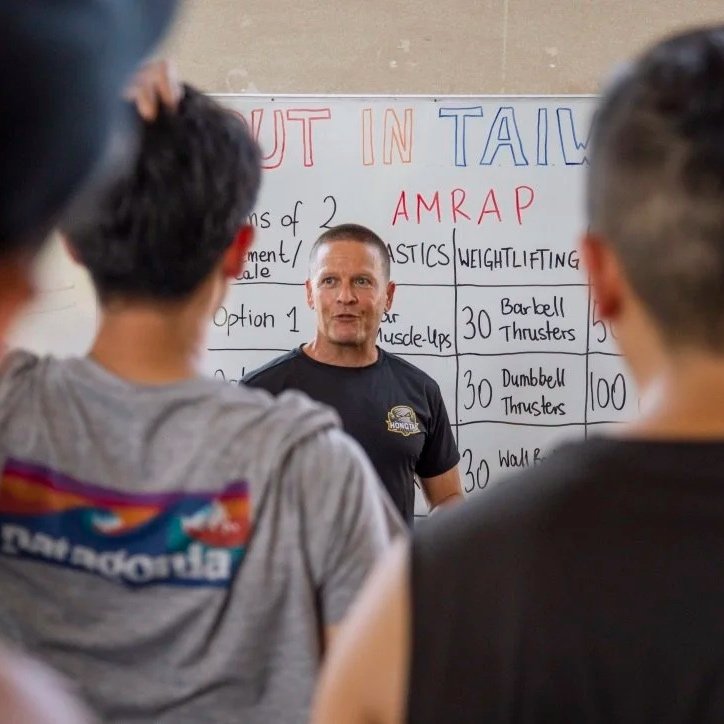
WOD (Workout of the Day): The main workout programmed for each class. It changes every day and is written on the whiteboard. The WOD is what makes CrossFit "constantly varied," you rarely repeat the exact same workout.
AMRAP (As Many Rounds/Reps As Possible): A timed workout where you perform a set of exercises in a cycle and try to complete as many rounds as you can before time runs out. For example, "10-minute AMRAP: 10 push-ups, 15 squats, 20 sit-ups" means you cycle through those three exercises as many times as possible in 10 minutes.
EMOM (Every Minute on the Minute): A workout format where you perform a specific movement at the start of each minute and rest for whatever time remains in that minute. For example, "EMOM 10: 5 pull-ups" means you do 5 pull-ups at the top of each minute for 10 minutes. The faster you finish your reps, the more rest you get.
MetCon (Metabolic Conditioning): The cardio-intensive portion of a CrossFit class. MetCons are designed to push your heart rate up and build endurance through high-intensity functional movements. Most WODs are MetCons.
For Time: A workout where the goal is to complete all prescribed exercises as fast as possible. Your score is your finishing time.
Tabata: A specific interval format, 20 seconds of maximum effort, followed by 10 seconds of rest, repeated for 8 rounds (4 minutes total). Named after Japanese researcher Dr. Izumi Tabata.
Chipper: A workout with a long list of different exercises, each performed once (not in rounds). You "chip away" at the list from top to bottom. Chippers are typically high-volume and test endurance.
Ladder: A workout where the rep count increases (or decreases) with each round. For example: 1-2-3-4-5-6-7-8-9-10 pull-ups, adding one rep per round.
Buy-In / Cash-Out: Exercises performed at the beginning (buy-in) or end (cash-out) of a workout, separate from the main portion. For example, "Buy-in: 800m run, then 3 rounds of 10 thrusters and 10 pull-ups."
Scoring & Standards
Rx / Rx'd (As Prescribed): Completing a workout exactly as written, the specified weight, the full range of motion, and no substitutions. Rx is the benchmark standard, but most athletes scale workouts to their current ability, which is completely normal and encouraged.
Scaled: Modifying a workout to match your fitness level. This can mean reducing weight, swapping a difficult movement for a simpler variation (e.g., ring rows instead of pull-ups), or reducing reps. Scaling is how CrossFit works for everyone, regardless of experience.
PR (Personal Record): Your best-ever performance on a specific lift or workout. Also called a "PB" (Personal Best) in some countries. Hitting a PR is one of the most celebrated moments in a CrossFit gym.
1RM (One-Rep Max): The maximum weight you can lift for a single repetition of a given movement. Knowing your 1RM helps your coach prescribe appropriate weights for workouts.
No Rep: When a judge or coach determines that a repetition didn't meet the movement standard, for example, not reaching full hip extension at the top of a thruster. The rep doesn't count and must be repeated.
Time Cap: The maximum time allowed to complete a workout. If you haven't finished when the time cap expires, your score is the number of reps you completed.
Key Movements
Snatch: Lifting a barbell from the ground to overhead in one continuous motion. One of the two Olympic lifts and one of the most technically demanding movements in CrossFit.
Clean: Lifting a barbell from the ground to the front rack position (resting on the shoulders). The other Olympic lift foundation. Variations include power clean (catching in a partial squat), squat clean (catching in a full squat), and hang clean (starting from the hips instead of the floor).
Clean & Jerk: A two-part lift, first clean the bar to your shoulders, then drive it overhead with a jerk. A staple of Olympic weightlifting and CrossFit competition.
Thruster: A front squat that flows directly into an overhead press in one smooth movement. Thrusters are used in many benchmark workouts (including Fran) and are notoriously demanding.
Wall Ball: Hold a medicine ball at your chest, squat below parallel, then explosively stand and throw the ball to a target on the wall (usually 10 feet for men, 9 feet for women). Catch and repeat. Simple but exhausting at high reps.
Deadlift: Lifting a barbell from the floor to a standing position with arms straight. One of the foundational strength movements.
Pull-Up: Hanging from a bar and pulling your chin above it. CrossFit uses strict pull-ups, kipping pull-ups, and butterfly pull-ups.
Muscle-Up: A pull-up that continues over the top of the bar or rings, ending in a dip position with arms straight. One of the more advanced gymnastics movements in CrossFit.
Handstand Push-Up (HSPU): In a handstand position against a wall, lower your head to the floor and push back up. Can be performed strict or with a kip.
Toes-to-Bar (T2B): Hanging from a pull-up bar and swinging your toes up to touch the bar. Tests grip strength, core strength, and coordination.
Double Under (DU): A jump rope technique where the rope passes under your feet twice per jump. A skill that frustrates many beginners but becomes second nature with practice.
Box Jump: Jumping from the floor onto a raised platform (typically 20" or 24" high) and standing to full extension at the top.
Burpee: Starting from standing, drop to the floor (chest and thighs touch), then push back up and jump with hands overhead. The universal exercise everyone loves to hate.
Pistol (Squat): A single-leg squat performed all the way down to the bottom position with the other leg extended in front. Requires strength, balance, and mobility.
Kipping: Using a swinging hip motion to generate momentum for movements like pull-ups, toes-to-bar, or handstand push-ups. Kipping allows athletes to perform more reps at higher intensity compared to strict (no-momentum) versions.
Equipment
Barbell: A steel bar (typically 20kg for men, 15kg for women) loaded with bumper plates for weightlifting movements.
Kettlebell (KB): A cast-iron weight shaped like a ball with a handle. Used for swings, cleans, snatches, Turkish get-ups, and goblet squats. Common weights are measured in "poods" (1 pood = ~16kg).
Medicine Ball / Med Ball: A weighted ball (typically 6-14kg) used primarily for wall balls, but also for sit-ups and other movements.
GHD (Glute-Ham Developer): A machine used for GHD sit-ups, back extensions, and hip extensions. Develops core and posterior chain strength.
Rower / RowErg: An indoor rowing machine (usually a Concept2) used for cardio intervals and MetCons. Also one of the 8 HYROX stations.
SkiErg: A machine that simulates cross-country skiing with a standing pull-down motion. Used in both CrossFit and HYROX training.
Rig: The large metal structure in a CrossFit gym with pull-up bars, attachment points for rings, and various other stations. The centerpiece of every box.
Rings: Gymnastic rings suspended from the rig, used for ring dips, muscle-ups, ring rows, and other gymnastics movements.
AbMat: A small curved pad placed behind your lower back during sit-ups to support the lumbar spine and allow full range of motion.
Bumper Plates: Rubber-coated weight plates designed to be safely dropped from overhead. Color-coded by weight according to Olympic standards.
Gym Culture
Box: The CrossFit word for "gym." Called a box because many CrossFit gyms operate out of simple, open warehouse-like spaces.
Affiliate: A gym that is officially licensed by CrossFit, LLC. Hongtai CrossFit is an affiliate. Affiliates are independently owned, not franchises.
Whiteboard / The Board: The whiteboard where the day's WOD is written, and where athletes record their scores. The whiteboard is central to CrossFit culture, it creates accountability and friendly competition.
Open Gym: Scheduled time when the gym is open for members to work on individual skills, make up missed workouts, or do their own programming. There is no coached class during Open Gym.
Drop-In: When a member of another CrossFit gym visits your box for a single class. Drop-in athletes are welcome at Hongtai CrossFit, check our Drop-In page for details.
Foundations / On-Ramp: An introductory course required before joining regular CrossFit classes. At Hongtai, the Foundations Course consists of 6 private coaching sessions covering the fundamental movements, plus 1 month of guided group classes.
Scaling: See "Scaled" above. The ability to scale every workout is what makes CrossFit accessible to all fitness levels. Your coach will help you find the right scale for each workout.
Benchmark Workouts
The Girls: A collection of named benchmark workouts used worldwide to measure fitness progress. The original six (Fran, Diane, Elizabeth, Angie, Barbara, Chelsea) were introduced by CrossFit founder Greg Glassman in 2003 and have since expanded to 27. They are named after women, similar to how storms are named, because they "leave you on the floor."
Hero WODs: Named workouts honoring fallen military, law enforcement, and first responder personnel. They are typically longer and more grueling than The Girls. The most famous is Murph (1-mile run, 100 pull-ups, 200 push-ups, 300 squats, 1-mile run, often with a weight vest), performed by CrossFit gyms worldwide on Memorial Day.
Fran: The most iconic CrossFit benchmark. 21-15-9 reps of thrusters and pull-ups, performed for time. Elite athletes finish in under 2 minutes; most athletes in 5-10 minutes. Your "Fran time" is practically your CrossFit identity card.
Murph: The most iconic Hero WOD (see above). Named after Navy Lieutenant Michael Murphy, who was killed in Afghanistan in 2005. The workout he created was originally called "Body Armor."
CrossFit Total: The sum of your 1-rep max back squat, shoulder press, and deadlift. A pure strength benchmark, no cardio, no time component.
Fight Gone Bad: Three rounds of five exercises, each performed for 1 minute with 1 minute rest between rounds. Your score is your total reps across all movements
CrossFit Competition
CrossFit Open: An annual worldwide online competition (typically February-March) where athletes perform announced workouts and submit their scores. The Open is the entry point for the CrossFit Games season and is open to all athletes regardless of skill level.
CrossFit Games: The annual championship event where the fittest athletes in the world compete across multiple days of varied events. The ultimate test of fitness.
Quarterfinals / Semifinals: Stages of the CrossFit Games qualification process between the Open and the Games.
HYROX Terms
HYROX: A global fitness racing series that combines running with functional workout stations. Every HYROX race in the world follows the identical format, 8 rounds of a 1km run followed by a functional exercise station, for a total of 8km of running and 8 workout stations.
The 8 HYROX Stations (in order):
SkiErg, 1,000 meters on a skiing machine
Sled Push, push a weighted sled 50 meters
Sled Pull, pull a weighted sled 50 meters using a rope
Burpee Broad Jump, 80 meters of burpees with a forward jump
Rowing, 1,000 meters on a rowing machine
Farmer's Carry, carry heavy kettlebells for 200 meters
Sandbag Lunge, lunge with a sandbag on your shoulders for 100 meters
Wall Balls, 100 repetitions
HYROX Divisions:
HYROX Open, individual entry level (lighter weights)
HYROX Pro, individual advanced (heavier weights)
HYROX Doubles, teams of two (same or mixed gender)
HYROX Relay, teams of four, each completing 2 stations
HYROX 365: The official HYROX training program available at licensed gyms, designed to prepare athletes for HYROX races through structured weekly training.
Roxzone: The race venue area where spectators can watch athletes complete the workout stations.
PFT (Pro Fitness Tour): The elite HYROX competition series featuring the world's top-ranked HYROX athletes.